AI in logistics: demand forecasting and workforce planning, a success case
A real example from Crata of AI in logistics used for demand forecasting and operational planning.

In logistics, daily planning rarely starts from certainty. Volumes fluctuate, demand peaks appear unexpectedly and many workforce decisions are made with incomplete information.
In an industry where every deviation directly impacts costs and service levels, the lack of reliable forecasting often translates into inefficiencies, operational risk and rising expenses.
Being able to anticipate demand is essential to properly size teams, shifts, and operational capacity in complex logistics environments.
In this article, we share a real AI in logistics success case where, together with a logistics company, we transformed daily operational data into a practical, decision-oriented planning system.
The goal was clear: reduce uncertainty, anticipate demand and provide operations teams with a reliable, data-driven decision-making framework.
Table of contents
AI in logistics enables organizations to anticipate demand and plan operations using historical data and predictive models, replacing manual estimates with evidence-based forecasts.
In practice, applying AI in logistics means using data to understand what is likely to happen and acting before operational issues arise.
It is not about automating for the sake of automation, but about supporting decision-making in environments where variability is high and the margin for error is low.
AI also frees teams from repetitive, low-value tasks that consume time without improving outcomes: consolidating data, cross-checking spreadsheets, preparing reports, or manually updating systems.
Technology takes care of the mechanical work so people can focus on deciding and improving.
When implemented correctly, AI helps operations teams answer critical questions: what volume will arrive, when it will arrive, what impact it will have, and how to organize resources to absorb it efficiently.
In the day-to-day reality of many logistics companies, planning often starts with a simple question that does not always have a clear answer: How much volume are we going to receive, and how should we organize ourselves to handle it?
The absence of reliable logistics demand forecasting typically leads to issues such as:
- Constant changes in shift planning
- Difficulty anticipating activity peaks
- Heavy reliance on spreadsheets and manual estimates
- Tension between planning and operations teams
When volumes vary by day and by brand, reacting too late has a direct impact on costs, service quality, and team workload.
Context
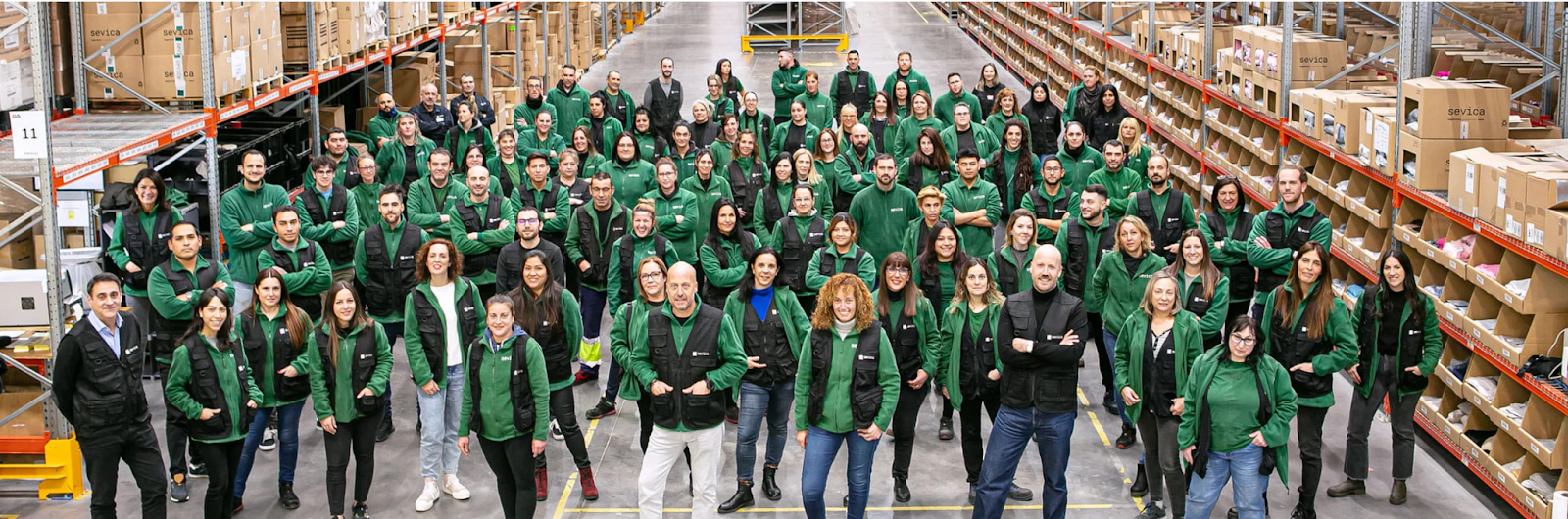
Sevica is a multi-client logistics company managing operations for different brands, with inbound volumes that vary significantly depending on the day and the customer.
The main challenge was visibility and predictability: unifying scattered data sources, building a centralized, data-driven decision environment, anticipating daily inbound units by brand and understanding how those volumes translated into real workforce needs in the warehouse.
All of this served a clear objective: improve operations through data while continuing to deliver reliable service to clients, even in highly variable scenarios, maintaining high service quality through innovation.
Objective
The objective was clear and highly operational:
- Anticipate daily and weekly demand
- Reduce uncertainty in planning
- Turn forecasts into actionable decisions
- Improve team and shift organization
This was not just about having more data, but about reinforcing an operational strategy and culture focused on excellence: planning better, anticipating change, innovating and continuously raising service standards.
To address this challenge, Crata AI designed a solution that combines logistics demand forecasting with operational workforce planning, fully integrated into the team's daily workflow.
The solution uses Machine Learning models to forecast demand and automates continuous updates using real daily operational data.
From a functional perspective, the solution enables teams to:
- Reliably predict demand by brand and day
- Detect patterns and peaks in advance
- Automatically update forecasts
- Reduce manual planning workload
This approach builds on Crata AI's demand forecasting solutions, specifically adapted to logistics operational contexts.
The real value emerges when demand forecasts are translated into concrete decisions about people and operational capacity.
In this case, demand forecasting does not stop at predicting unit volumes. Based on those forecasts, the system:
- Converts forecasted units into workload
- Applies brand-specific productivity ratios
- Calculates required weekly FTEs
An FTE, or Full-Time Equivalent, represents the workload of one full-time employee.
This approach allows teams to plan resources in advance, decide on reinforcements and organize shifts without having to manage individual-level decisions.
.png)
Data infrastructure and automation
To ensure reliability and scalability, Crata AI designed and implemented a robust, automated data infrastructure.
Automation ensures that forecasts are continuously updated without manual intervention.
The architecture includes:
- Daily ingestion of real operational data via API
- Centralization of information in a cloud-based data lake
- Automated processing and model execution
- A foundation designed to scale alongside operations
This approach relies on a data infrastructure built specifically for business-driven AI projects.
Visualization and decision-making
A key success factor of the project was making information accessible to non-technical stakeholders.
Results are visualized in an operational Power BI dashboard, where teams can:
- Compare demand forecasts against real data
- Analyze weekly trends
- Understand the operational impact of each brand
- Make decisions with a shared, clear view of the situation
Visualization transforms AI into a practical day-to-day tool rather than an isolated system.
.png)
Operational impact
Beyond technology, the real impact is reflected in how teams work differently.
Having reliable forecasts and a clear view of operational load allows teams to move from reactive planning to anticipatory planning.
In Sevica's case, this translated into:
- Greater ability to anticipate demand peaks
- Better organization of resources and shifts
- Reduced reliance on manual estimates
- Stronger alignment between planning and operations
AI makes sense when demand variability directly affects costs and service levels.
Solutions like this are especially valuable when:
- Activity volumes change frequently
- Operations rely heavily on workforce planning
- Planning consumes a significant amount of time
- There is sufficient historical data to learn from
In these contexts, AI in logistics provides greater control without introducing unnecessary complexity.
Conclusion
AI applied to logistics is not about complex models or technology for its own sake. It is about anticipation, planning and better-informed decisions.
The Sevica case demonstrates how, with the right approach, AI can be seamlessly integrated into daily logistics operations and become a real lever for control, predictability, and planning. A company with a strong orientation toward operational excellence and customer service can use AI in a practical way to reinforce its operating model.
Technology thus becomes a natural extension of how the organization works: anticipating change, planning better and delivering increasingly reliable service in complex environments.
At Crata AI, we design these solutions so technology is not an experiment, but an operational tool with direct business impact.
Explore AI solutions for logistics
If you would like to go deeper into these approaches, you can explore our demand forecasting, data infrastructure, or start with an AI Quickstarter to evaluate how AI can be applied pragmatically to your logistics operations.
Contact: info@crata-ai.com
FAQs in AI for logistics
What is AI in logistics?
It is the use of data and predictive models to anticipate demand, optimize operations, and plan resources in logistics environments.
How does AI help with demand forecasting?
It identifies patterns and anticipates activity peaks, improving accuracy compared to manual methods.
Can AI be used for workforce planning in logistics?
Yes. Based on demand forecasts and productivity ratios, it is possible to estimate required FTEs and plan resources in advance.