Cost reduction through AI: Unlocking crucial savings for your company
Discover how to reduce costs in your company with AI from automation and sales to supply chain optimization.

Table of contents
Reducing costs and improving efficiency is no longer just a financial decision. It has become a condition for competitiveness.
Companies today operate in an environment defined by margin pressure, economic slowdown and the constant need to do more with less.
In this landscape, artificial intelligence (AI) has shifted from a technological promise to a tangible driver of profitability and resilience.
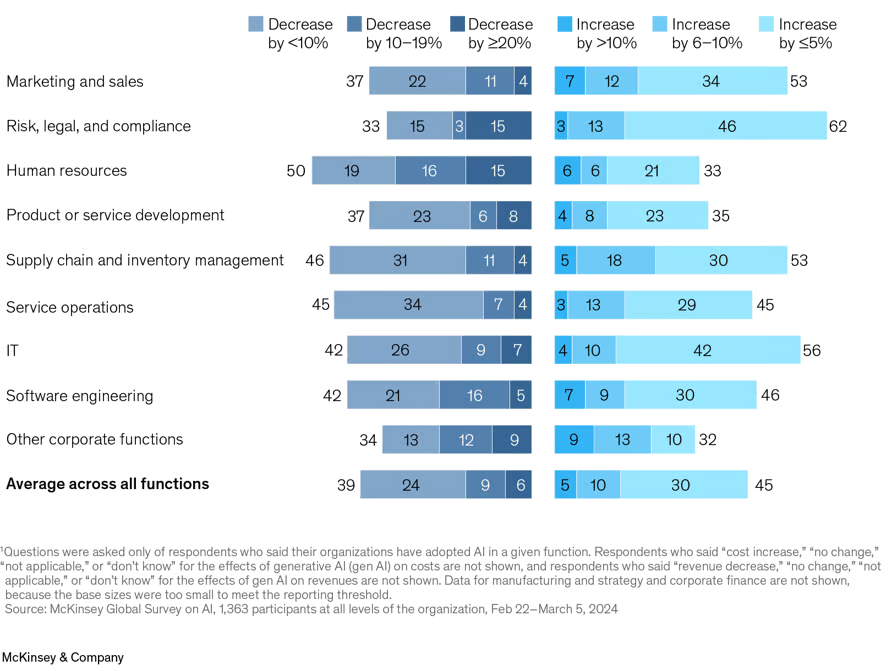
According to The State of AI report (2024) by McKinsey & Company, more than 40% of companies already using generative AI have reduced their operating costs, especially in HR, operations, and IT.
Almost half report increased revenue across functions like marketing, sales, and supply chain.
But the key question is not whether AI can reduce costs, but how to apply it effectively within your organization.
Yes, and the data supports it.
According to McKinsey, organizations adopting an AI centric approach are achieving 20% to 40% reductions in operating costs thanks to automation, faster cycles, and more efficient use of talent and infrastructure.
AI helps identify inefficiencies, automate repetitive work, and anticipate problems before they generate extra costs. And the best part: results are measurable from the early stages.
Cost decrease and revenue increase from generative AI adoption in 2023, by function,1 % of respondents
AI powered automations: Less operational load, more efficiency
Automation is one of the most direct paths to cost reduction with AI.
When AI takes over repetitive, administrative, or support tasks, companies free up time and resources for higher value activities.
Examples of AI automations that reduce costs include intelligent virtual assistants and conversational systems capable of handling claims, coordinating appointments, or validating documents automatically.
These systems not only speed up customer service, they also reduce internal operational load and minimize human errors that often lead to costly rework. The areas where this impact is most visible include customer service, HR, and administrative processes.
In all of them, AI saves time, standardizes workflows, and eliminates manual tasks that consume resources.
If you want to learn more about AI Automations and how we build them in real projects, read our post.
Document optimization and quality control with AI
Document management and compliance are frequent sources of hidden operational costs.
Errors in validation, duplicated work, or long manual processes can lead to significant losses. Today, AI solutions can read, interpret, and validate technical or administrative documents automatically.
For example, large language models (LLMs) combined with intelligent agents can compare contracts, review regulations, or detect inconsistencies across different document versions.
This results in faster and more accurate processes, fewer revisions, and lower risk of error. It also frees teams from routine tasks and reduces reliance on manual labor in high volume areas.
AI for technical planning: Fewer hours, greater coherence. The Sacyr case
One of the clearest examples of AI driven cost reduction can be found in the construction sector.
Crata AI developed Miranda AI together with Sacyr, a global engineering and construction leader.
Miranda AI is an assistant capable of reading technical documents (specifications, reports, preliminary studies) and automatically generating structured work plans for complex tenders.
This solution drastically reduces preparation time, improves coherence across proposals, and optimizes the resources required for each project.
In practice, it means lower operating cost per tender, faster turnaround, and a stronger competitive position. A real example of how AI transforms productivity in sectors where technical time has a direct impact on profitability.
You don't need to be a large corporation to benefit from cost reduction with AI. Startups can apply the same efficiency strategies from their earliest stages.
Automating admin work, analyzing customer data, or generating intelligent reports allows teams to save time, reduce operational costs, and scale without increasing headcount.
Examples of how a startup can use AI to increase efficiency include:
- Automated customer support with chatbots trained on the company's own history of queries.
- Intelligent document processing for automatic classification and validation of invoices or contracts.
- Predictive analytics for sales or demand to anticipate market behavior and adjust commercial strategies.
- Automated reporting and smart dashboards that provide real time metrics without spreadsheets.
- Marketing optimization with AI driven audience insights and high performing message detection.
However, not every use case delivers the same return from day one. That's where AI Quickstarter comes in, a solution designed by Crata AI to help startups identify the highest impact AI initiatives, validate feasibility, and launch them within weeks.
The goal is not to build large scale systems immediately, but to lay the foundation. Understanding the data, setting priorities, and creating a roadmap for scalable growth.
This approach turns AI into a real engine of efficiency and growth, not an experimental cost. It allows startups to move faster, with fewer resources, and with a clear view of impact and sustainability.
.png)
Cost reduction with AI in numbers
Recent studies point in the same direction:
- McKinsey (2025): 80% of companies investing in AI say efficiency is a core objective of their initiatives.
- Gartner (2025): 54% of Infrastructure and Operations leaders are adopting AI specifically to reduce costs.
- EY (2025): 56% of executive teams report that AI has already generated cost savings or increased profits, up from 45% in 2024, highlighting an increasingly clear financial impact.
Taken together, these figures reveal a strong trend. AI driven operational efficiency translates directly into lighter cost structures, less manual workload, fewer errors and a more strategic use of time and resources.
AI does not only optimize processes, it redefines how companies control and reduce their costs.
Conclusion: From potential to measurable results
AI is redefining operational efficiency.
What once required weeks of manual work can now be done in hours, with greater accuracy and lower cost.
At Crata AI, we help organizations move from "we want to use AI" to "we are already seeing results".
We design custom solutions that reduce costs, improve processes, and accelerate profitability with a clear focus on real, measurable impact.
Want to discover how to apply AI to do more with less in your company?
Let's build the path toward smarter efficiency.
Contact us at info@crata-ai.com
McKinsey & Company (2025). The AI-centric imperative: Navigating the next software frontier
McKinsey & Company (2024). El estado de la IA a principios de 2024: la adopción de la IA generativa aumenta y comienza a generar valor.
McKinsey & Company (2025). The State of AI: How Organizations Are Rewiring to Capture Value
Gartner (2025). Survey: 54 Percent of Infrastructure and Operations Leaders Are Adopting AI to Cut Costs
EY (2025). European AI Barometer: The Workforce’s Response to AI


