Digital transformation and artificial intelligence in construction in Spain
A practical look at digital transformation and AI in the Spanish construction industry, with real use cases and impact.

Construction is one of the pillars of the Spanish economy. According to the Construction Observatory (2024), it accounts for around 5% of Spain's GDP and employs more than 1.4 million people, playing a critical role in infrastructure, housing and the energy transition.
However, this central role contrasts with a well-known reality within the sector: its level of digitalization remains low.
While other industries have made significant progress in automation, advanced analytics, and artificial intelligence, construction still relies heavily on manual processes, fragmented documentation, and poorly connected systems.
At a global level, this gap has a direct impact on productivity. As early as 2017, McKinsey pointed out that construction productivity had grown at roughly 1% per year over several decades, far below the pace of the overall economy.
In this context, digital transformation in construction is no longer an extra, it has become a necessity.
The key question is no longer whether technology can create value, but why adoption has been so slow and what is changing now for AI to start having a real impact on costs, timelines, and decision-making.
Table of contents
Digital transformation in construction is the process of redesigning key industry processes using technology, data and artificial intelligence to improve productivity, cost control, timelines and decision-making across the entire project lifecycle.
Beyond the definition, it is not about accumulating tools or digitizing isolated tasks. It involves changing how construction projects are planned, executed and controlled, supported by data and automation.
In practice, this means moving from:
- Manual processes and fragmented documentation
- Integrated, data-driven workflows supported by advanced analytics and AI.
McKinsey (2024) identifies construction as one of the sectors with the greatest potential for productivity improvement, precisely due to its historically low level of digitalization.
Digitalization in construction in Spain is progressing slowly and unevenly, with widespread use of basic tools and very limited adoption of data analytics, cloud infrastructure and artificial intelligence.
Industry reports are consistent in this diagnosis. Most companies rely on email, office software, or electronic invoicing, but only a small minority have systematically integrated advanced technologies.
Some key figures illustrate this reality:
- Only 18.7% of construction companies perform internal data analytics. (Observatorio Industrial de la Construcción, 2023)
- Adoption of cloud infrastructure is significantly lower than in other sectors.
- The use of artificial intelligence in construction remains marginal.
This situation explains why productivity in the sector continues to grow more slowly than in other industries, a structural gap that has persisted for decades.

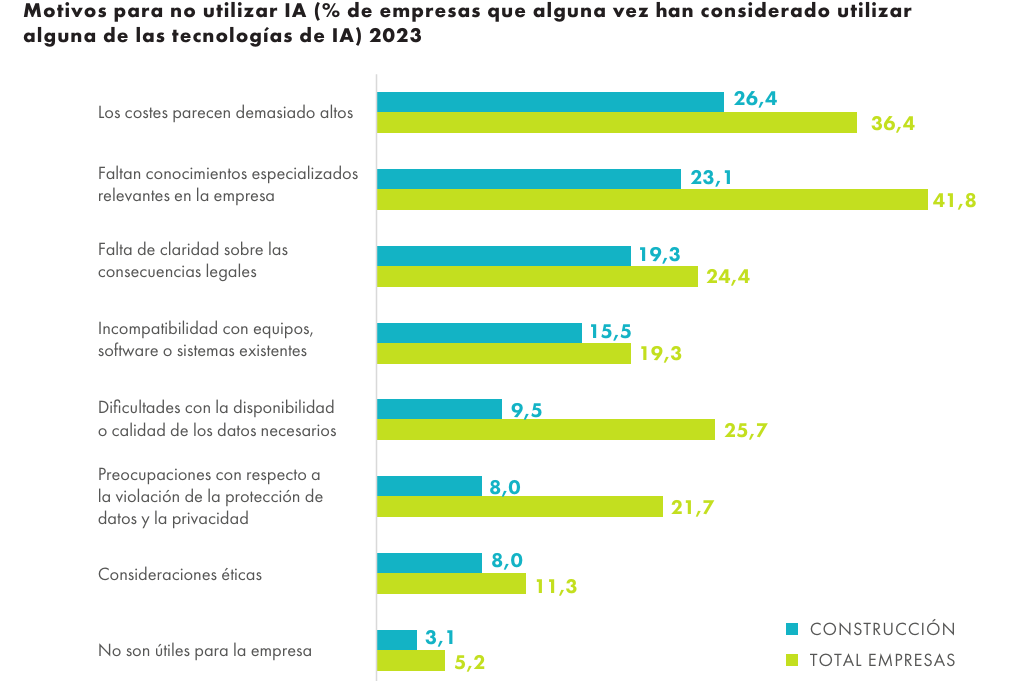
AI adoption in construction remains limited due to a combination of structural factors: sector fragmentation, low perceived ROI, lack of digital talent, poor data quality, and regulatory pressure, especially in public procurement.
In practice, these barriers take the following form:
Fragmented processes and stakeholders
Developers, engineering firms, construction companies and subcontractors often work with poorly standardized information flows.
Uncertainty around return on investment
Many companies prioritize short-term operational continuity over investments that require organizational change.
Shortage of digital talent and an aging workforce
The lack of technical profiles limits the sector's real capacity to adopt advanced technologies.
Low-quality data and disconnected systems
Without structured and reliable data, scaling advanced analytics and AI becomes extremely difficult.
Administrative burden and regulatory environment
Compliance and administrative processes absorb resources that could otherwise be allocated to innovation.
The result is a recurring pattern: strategic interest in AI, but difficulty moving from pilots to real business adoption.
AI in construction is used to automate planning and documentation, predict cost and schedule deviations, optimize execution, improve safety, and extend the value of BIM through analysis and simulation.
When applied to concrete business problems, AI stops being experimental and starts delivering measurable impact.
High-impact use cases of AI in construction
Planning and documentation automation
- Automated analysis of technical specifications, reports, and drawings.
- Extraction of tasks, dependencies, and resources.
- Significant reduction in time spent on planning.
A clear example of this approach is the solution developed for Sacyr, where the implementation of AI agents for construction schedule automation dramatically reduced planning timelines. A process that traditionally required months of manual work was reduced to just a few hours, accelerating project kick-off and improving planning reliability from early stages.
Predictive analytics for costs and schedules
- Early identification of deviations before they materialize.
- More accurate estimates in early project phases.
- Reduced financial risk.
To go deeper into predictive analytics for businesses, you can explore our dedicated solution's page.
Execution and procurement optimization
- Real-time visibility into project progress.
- Decision support for supplier negotiations.
- Lower probability of cost overruns.
Computer vision and site safety
- Monitoring site progress through images or video.
- Detection of risks and PPE compliance.
- Shift from reactive to proactive safety management.
Our dedicated blog post explores how computer vision supports safer, more proactive operations.
BIM and AI integration
- Comparison between planned and executed work.
- Scenario simulation before critical decisions.
- Improved coordination across technical teams.
Artificial intelligence in construction enables higher productivity, fewer errors and rework, reduced cost and schedule deviations, and better decision-making based on real-time data.
When digital transformation in construction focuses on critical processes, the benefits are clear:
- Productivity increases close to 20%. (Cámara de Comercio de Sevilla, 2024)
- Lower dependence on manual and administrative tasks.
- Fewer planning and execution errors.
- Better control of operational and financial risk.
One less visible but highly strategic impact is the release of senior talent. By eliminating repetitive tasks, experienced professionals can focus on supervision, analysis, and high-value decision-making.
The future of construction points toward a more predictable, data-driven operating model.
Pressure on costs, timelines, and resources is forcing the sector to rely on systems capable of anticipating problems rather than reacting once it is too late.
In the coming years, companies leading digital transformation in construction will share several common traits:
- Continuous visibility into costs, timelines, and risks.
- Use of AI from early phases such as estimation, planning, and feasibility analysis.
- Real integration between BIM, construction data, and advanced analytics.
- Reduction of manual and administrative tasks through automation.
- More productive technical teams focused on supervision and decision-making.
This shift is already reflected in the market. The global AI for construction industry market is expected to exceed USD 24.3 billion by 2030, signaling that artificial intelligence is becoming a core part of construction operating models, according to Mordor Intelligence.
In this context, competitive advantage will come from applying technology with clear criteria, prioritizing critical processes and high-impact decisions.
Companies that understand this early will be better positioned to lead the next phase of the industry.
Next steps
If your company is evaluating how to move forward with digital transformation and artificial intelligence in construction, an initial conversation can help clarify where to start.
Through our AI Quickstarter, we analyze your context, key processes and potential use cases to define a clear, prioritized roadmap focused on real business impact.
Book a free meeting and clarify the next steps before investing.
Contact: info@crata-ai.com
FAQs about digital transformation and AI in construction
What is digital transformation in construction?
It is the process of redesigning key construction processes using technology, data, and artificial intelligence to improve productivity, cost control, timelines and decision-making.
How can AI be used in construction?
AI is used to automate planning, analyze technical documentation, predict cost and schedule deviations, optimize execution and improve safety through computer vision.
How does AI impact the construction industry?
Artificial intelligence improves planning accuracy, reduces cost and schedule overruns, automates administrative tasks, enhances site safety, and supports decision-making through predictive analytics based on real project data.
Does artificial intelligence replace engineers?
No. AI supports engineering teams by eliminating low-value tasks and improving decision quality, while expert knowledge remains essential.
Is AI only for large construction companies?
No. AI is increasingly accessible and can generate significant impact for small and mid-sized companies when applied in a focused and strategic way.
Where should construction companies start with digitalization?
By targeting the processes with the greatest impact on costs, timelines, and risk, starting with clear, scalable use cases.
How is AI used in construction cost estimation?
AI is used in cost estimation by analyzing historical data, technical documentation, and project variables to generate more accurate budgets, anticipate risks, and improve cost and schedule reliability from early stages.
Observatorio Industrial de la Construcción (2025). Informe sobre el sector de la construcción 2024
McKinsey (2024). Delivering on construction productivity is no longer optional
McKinsey (2018). Artificial intelligence: Construction technology’s next frontier
Cámara de Comercio de Sevilla (2024). Tendencias Digitales Construcción
McKinsey Global Institute (2017). Reinventing Construction: A Route to Higher Productivity
Observatorio Industrial de la Construcción (2023). El sector de la construcción y las TIC
Mordor Intelligence (2025). AI In Construction Market Size & Share Analysis - Growth Trends And Forecast (2025 - 2030)
.png)
