Enterprise chatbots: how to manage internal knowledge with AI
Practical overview of how enterprise chatbots work and how businesses use them to manage internal knowledge.

Most companies already have the information they need to operate efficiently. The real challenge is not a lack of data, but the difficulty of finding it, understanding it, and using it at the right moment.
This is where enterprise chatbots, combined with AI document classification, become a true competitive advantage.
This article explains what enterprise chatbots are, how they work, and why they are becoming a key component for scaling operations without adding complexity.
Internal knowledge is one of the two main deployment scenarios inside a company. For the full picture, covering types, architecture, use cases by department and how to design a pilot you can measure, we go through it in our complete guide to AI chatbots for business.
Table of contents
Enterprise chatbots are AI-powered internal assistants that allow employees to access organizational knowledge using natural language, without manually searching through documents or disconnected systems.
Unlike traditional chatbots, these assistants:
- Access real internal documentation.
- Understand questions phrased in everyday language.
- Provide up-to-date, contextual responses.
They act as an intelligent layer on top of corporate knowledge, reducing operational friction and dependency on specific individuals.
Most organizations do not have a technology problem. They have an access-to-knowledge problem. Information exists, but it does not flow.
According to Gartner (2023), 47% of digital workers struggle to find the information they need to perform their jobs effectively. This daily friction directly impacts productivity, operational quality and decision-making.
This problem typically appears in three main ways:
Dispersed information
Documents spread across folders, intranets, emails, CRMs and ERPs lead to:
- Time wasted searching for information.
- Inconsistencies across document versions.
- Departmental silos.
This is where AI document classification plays a key role, enabling organizations to centralize, structure and tag internal knowledge so it becomes truly accessible.
Outdated information
Even when information exists:
- It is not always the correct version.
- Multiple similar documents coexist.
- Employees are unsure which source is valid.
Enterprise chatbots always work with the most up-to-date documentation, reducing operational errors.
Loss of organizational knowledge
When employees leave:
- Critical experience is lost.
- Bottlenecks appear.
- Onboarding slows down.
A well-designed internal chatbot preserves this knowledge and makes it accessible across teams.
The common mistake: Technology without a roadmap
When companies realize their internal knowledge does not flow, the biggest mistake is implementing technology without a clear roadmap for business impact.
Structured approaches like the AI Quickstarter help identify which documentation truly matters, which processes can be automated and how to deploy enterprise chatbots with measurable results from the start.
An enterprise chatbot is built on three core layers.
1. Natural language understanding
Employees can ask questions as they would to a colleague, without technical commands or training.
2. AI document classification
Internal information is processed through:
- Content extraction from PDFs, Word files and databases.
- AI-driven document classification systems.
- Tagging and structuring of knowledge.
This transforms chaotic documentation into usable information.
3. Context-aware response generation
The system retrieves relevant information and generates clear, actionable responses without improvisation.

What is RAG?
RAG, or Retrieval-Augmented Generation, is the technology that allows enterprise chatbots to generate responses grounded in real, up-to-date internal information.
A RAG system combines information retrieval with natural language generation. It first identifies the most relevant fragments from internal documents and then generates the response using that context.
What RAG adds compared to other approaches
- Real information retrieval
Accesses authorized internal documents. - Verified responses
Answers are based on validated company knowledge. - Hallucination reduction
Responses are anchored in real documentation, not assumptions.
RAG, governance, and security
RAG-based enterprise chatbots respect role-based permissions and do not use internal documentation to train public models. This makes RAG essential for applying AI document classification while maintaining confidentiality and governance.
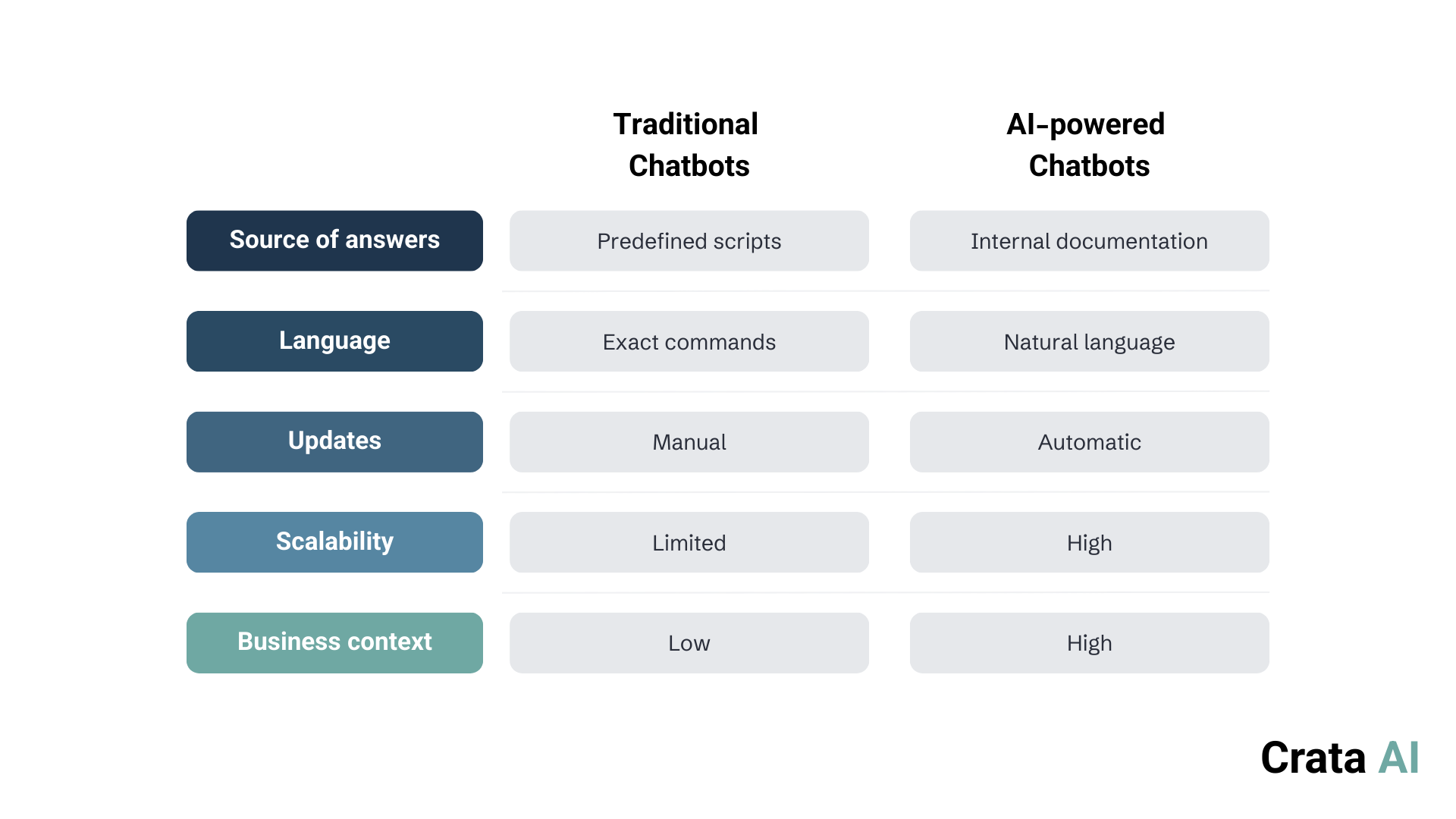
Traditional chatbots and AI-powered enterprise chatbots differ mainly in how they access information, handle language and scale across the organization. The comparison below highlights the key differences that impact reliability, maintenance and business context.
IT support and operations
- Immediate resolution of common incidents.
- Reduction of repetitive tickets.
- Access to internal technical procedures.
Legal and compliance
- Contract and policy queries.
- Support for internal audits.
- Secure access to sensitive documentation.
Knowledge management
- Fast access to manuals and processes.
- Knowledge transfer across teams.
- Reduced dependency on individual experts.
Projects and collaboration
- Accessible decision history.
- Centralized documentation.
- Improved cross-team coordination.
Human resources
- Answers to frequently asked questions.
- Onboarding support.
- Automation of internal processes.
- Time savings: up to 80%–90% reduction in manual search time.
- Cost efficiency: operational cost per ticket reduced by more than 50%.
- 24/7 availability: instant responses without additional team load.
- Knowledge preservation: critical know-how stays within the organization.
- Security and control: role-based access and data governance.
Internal chatbots are evolving from information assistants into intelligent systems that execute tasks and adapt to employee context.
According to Gartner (2025), by 2028 more than 20% of workplace applications will include AI-driven personalization.
This signals a structural shift: intelligence is becoming a standard layer in enterprise software.
Next steps in the evolution of internal chatbots
- Automatic knowledge updates
The system incorporates new documents as soon as they are created or modified, without any manual intervention. - Continuous improvement through new internal knowledge
AI document classification allows the assistant to continuously improve its capabilities as the organization generates new content. - Action execution, not just answers
The chatbot does more than explain how to do something. It can activate AI agents capable of initiating processes, submitting requests, or automating internal tasks autonomously by connecting information, rules, and actions without manual intervention. - Dramatic reduction in onboarding time
New employees gain access to operational knowledge from day one, without relying on specific individuals.
AI document classification acts as the engine that enables knowledge to flow with minimal ongoing human effort.
Internal knowledge chatbots at Crata AI
At Crata AI, we design enterprise internal knowledge chatbots focused on real operational impact, not generic demos.
Our approach includes:
- Deep integration with internal documentation.
- AI document classification tailored to business context.
- Security and governance by design.
- Measurable productivity and efficiency gains.
Technology handles information organization and retrieval so teams can focus on executing strategy.
The next step
Internal knowledge rarely organizes itself. When it is not addressed structurally, it creates friction and unnecessary dependency.
Enterprise chatbots help bring order to dispersed information, ensure access to the right knowledge, and free teams to focus on higher-value work.
If you want to explore how this approach could fit your organization, you can book a free strategic session on the link below to review your context and discuss potential paths forward.
Contact: info@crata-ai.com
FAQs about enterprise chatbots
How do enterprise chatbots work?
They use AI to understand questions and respond with internal company knowledge, accessing documents and systems securely.
How do you build an enterprise chatbot?
By defining the use case, connecting internal documentation, and applying RAG. In complex environments, working with specialized partners like Crata AI ensures real impact.
How long does it take to implement an enterprise chatbot?
Simple use cases can be live in weeks. More complex integrations require additional analysis phases.
Is a standard chatbot tool or a custom enterprise chatbot better for internal knowledge?
For critical internal knowledge, a custom chatbot offers greater control, security and integration.
Is internal company information secure when using an AI chatbot?
Yes, internal information can be secure when an enterprise chatbot is designed with role-based access, data governance policies, and secure integrations.
What benefits does an enterprise chatbot bring to documentation?
It centralizes knowledge, reduces search time, and prevents the use of outdated information.
What is the cost of an enterprise chatbot?
Costs depend on scope, document volume, integrations, and security requirements. Simple cases require moderate investment, while complex solutions need tailored design.
What are the limitations of an enterprise chatbot?
An enterprise chatbot can only respond and act on the information and processes it can access. Effectiveness depends on documentation quality, AI document classification, and a clearly defined use case.
Gartner (2023). Gartner Survey Reveals 47% of Digital Workers Struggle to Find the Information Needed to Effectively Perform Their Jobs
Gartner (2025). Gartner Predicts Over 20% of Workplace Apps Will Use AI-Driven Personalization Algorithms for Adaptive Worker Experiences by 2028
AWS (2025). What is Retrieval-Augmented Generation (RAG)?


