The future of legal work: reducing manual tasks with AI agents
AI doesn't replace lawyers; it reduces the repetitive tasks around legal work to increase billable efficiency.

Artificial intelligence is redefining how law firms operate. Not by replacing legal judgment, but by transforming how knowledge is accessed, experience is reused and repetitive tasks are executed.
Firms that are moving forward are focused on reducing operational friction around legal work, improving billable efficiency and scaling without proportional hiring.
In this context, legal AI agents are emerging as an infrastructure layer that enables firms to systematize internal knowledge and apply it consistently in daily legal operations.
Law firms can use legal AI agents trained on their internal knowledge to automate repetitive tasks such as legal research, document drafting and precedent retrieval.
These systems operate on the firm’s own documents, formats and decision criteria, reducing operational workload and minimizing hallucinations while maintaining control, traceability and confidentiality.
One example is Themia, a legal AI agent designed to work on a firm’s own documents, criteria and workflows instead of relying on generic tools.
In practice, these agents integrate into daily legal work and function as an operational layer that reduces friction in mechanical tasks and frees time for higher-value work.
Law firm partners are not looking for technological promises. They are looking for real leverage: how to increase billable efficiency, maintain quality and grow without proportional hiring.
Legal AI agents are emerging as a practical response.
The core of the profession remains deeply human: judgment, trust, client relationships and negotiation.
What is changing is how legal knowledge is accessed, reused and converted into operational capacity within the firm.
We are moving from a model based on individual expertise and craft to scalable systems where knowledge is structured, shared and consistently applied.
A legal AI agent enables law firms to automate repetitive tasks, centralize internal knowledge and apply it consistently across daily workflows, reducing operational friction and improving efficiency without losing control or quality.
In everyday legal work, a significant portion of time is spent searching for information, reusing previous documents, adapting formats and verifying content.
These tasks are necessary, but they are operational and consume hours of highly qualified professionals.
Over the past year, many legal teams have started experimenting with generic AI tools to accelerate these processes. However, their use often introduces additional friction:
- Asking a question in one tool
- Searching a database elsewhere
- Looking through the DMS
- Reformatting results in Word
- Manually verifying everything
This friction, combined with hallucinations and unreliable responses, often cancels part of the efficiency gains.
A bespoke legal AI agent like Themia from Crata AI works differently:
- Works with the firm’s own documents, templates and criteria
- Access to company data within a clear security and governance framework
- Respects internal formats and style
- Operates within governance rules and access controls
- Integrated into real workflows
Instead of being “another tool” or just a chatbot, it behaves more like a knowledge colleague. It feels like another member of the team.
For example, in a corporate law firm (Crata AI’s client), lawyers estimated they spent between 20% and 30% of their time reusing and adapting previous documents.
After centralizing and structuring their knowledge base for AI-assisted retrieval, that proportion decreased significantly, freeing hours each week for higher-value work.
This is the philosophy behind Themia, the legal AI agent developed by Crata AI: systems designed around how law firms actually work, not around the capabilities of a generic model.
AI is transforming legal work by automating repetitive tasks, structuring internal knowledge and reducing operational friction, allowing lawyers to spend more time on judgment, strategy and client relationships.
Today, legal work is undergoing a silent transition. The pressure to respond faster, handle more documentation and maintain quality is exposing operational limits that were previously absorbed with more working hours.
Across legal teams and knowledge-intensive organizations and based on our consulting and AI agent development work, we see recurring patterns:
- Highly paid lawyers doing formatting, synthesis and other automatable tasks
- Hallucinations creating legal risk and eroding trust
- Uncontrolled use of public AI tools
- Time lost searching emails, folders and databases
- Senior lawyers overloaded with internal questions
- Knowledge trapped in people’s heads
Interestingly, the biggest barrier we still see is not technical performance. It is trust.
A single incorrect answer can damage trust more than dozens of correct answers can build it.
This is where structured knowledge and bespoke legal AI agents like Themia become critical. When a firm’s knowledge is centralized, curated and systematized, AI outputs become more reliable, explainable and aligned with firm standards.
Built on that foundation, a comprehensive legal AI agent like Themia can automate high-friction tasks while operating within the firm’s knowledge base, allowing lawyers to focus more on judgment and client work.
AI does not replace lawyers. It reduces the repetitive tasks around legal work.
At its core, the legal profession remains inherently human. In many ways, AI can make it more human by freeing lawyers from low-value mechanical work and giving them more time for analysis, strategy and relationships.
In many law firms, only 10% to 20% of the work is truly high-value judgment and client interaction. The rest involves preparation, searching, comparison and drafting, areas where AI acts as leverage.
From individual expertise to systematized knowledge
Historically, a firm’s value resided in:
- Partner expertise
- Personal templates and know-how
- Tacit judgment and unwritten rules
- Memory of past cases
In other words, value lived in people’s heads and personal files. This makes quality difficult to standardize and scale.
When knowledge is systematized, firms gain consistency across teams, better scalability and healthier margins. They also reduce dependency on specific individuals and onboarding risk.
Across our experience building legal AI systems, one pattern is clear: firms that benefit most from AI are not necessarily the most innovative, but the most structured.
AI amplifies how organized a firm already is. If knowledge is fragmented, AI exposes chaos faster. If knowledge is structured, AI scales excellence.
This is why structured knowledge is the foundation of effective legal AI adoption.
Themia was built around an idea we repeatedly heard from business lawyers:
“We don’t just apply the law or generic AI answers. We apply our firm’s interpretation of the law, in our format and standards.”
Legal work is not just legal knowledge. It is the consistent application of a firm’s judgment. Generic tools cannot capture that nuance. A bespoke legal AI agent can.
Preparing a law firm for AI involves structuring, centralizing and governing knowledge and data so they can be used reliably within legal workflows instead of relying on fragmented systems or individual memory.
Infrastructure is often the hidden lever behind successful AI adoption.
Through multiple projects integrating AI into real business processes, we consistently see that data maturity and technology become competitive differentiators.
Firms that deliberately structure and operationalize knowledge scale more effectively.
A clear example is our work at Crata AI with a US-based firm, Untitled SLC.
By centralizing and automating financial and operational workflows, the firm gained faster decision-making, reduced low-value processing time and increased capacity without proportional hiring.
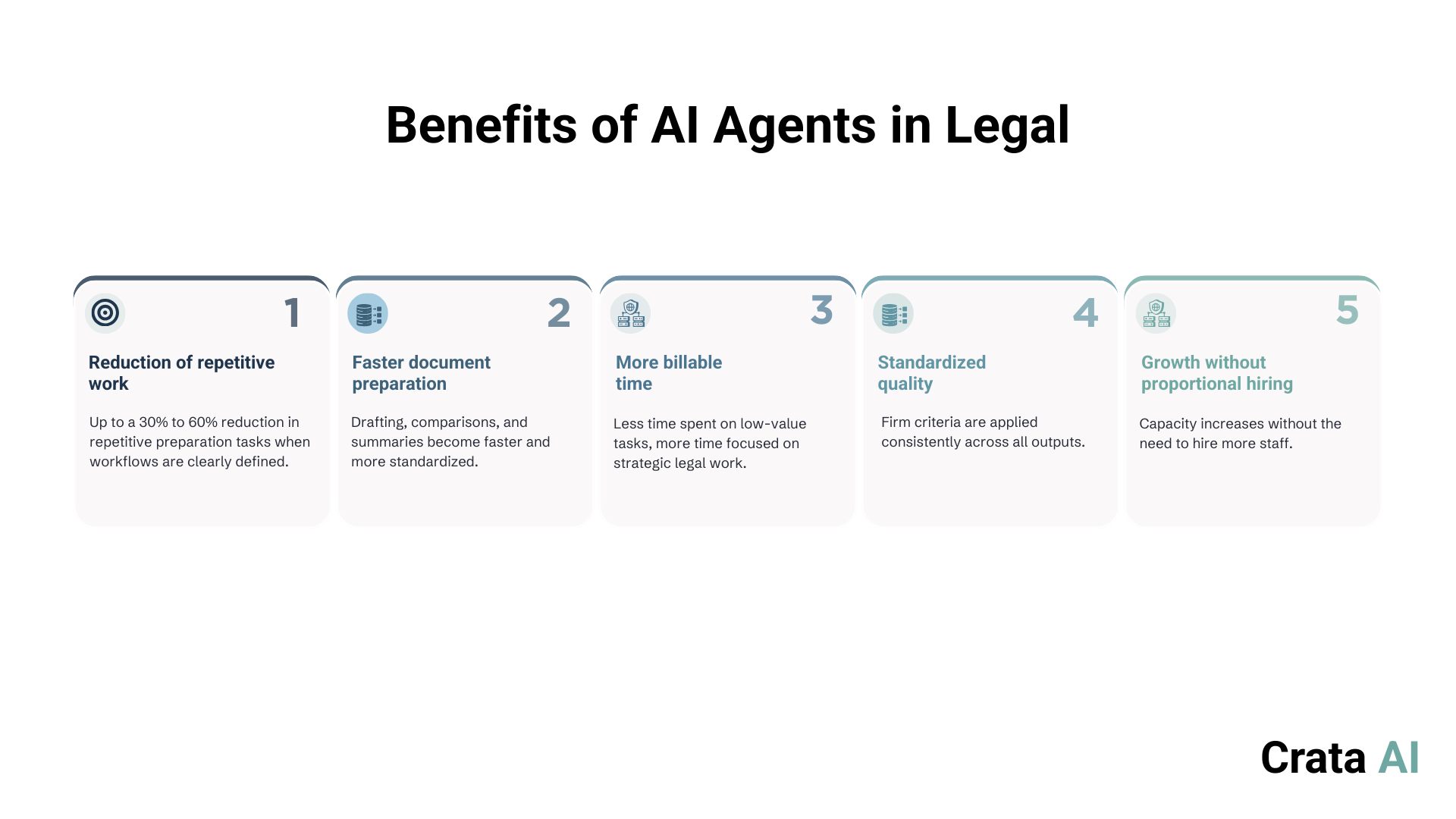
Legal AI agents generate direct impact on operational efficiency in law firms. They reduce repetitive work, accelerate document preparation, standardize quality and enable teams to scale without proportional hiring. These benefits appear when the agent operates within real workflows and legal context.
Is AI reliable and secure in a law firm?
Yes, if implemented correctly. Legal AI agents like Themia operate on controlled knowledge sources, access permissions, auditability and human oversight.
The risk is not the technology itself, but using it without governance.
Senior lawyers’ skepticism typically relates to:
- Incorrect outputs
- Reputational risk
- Loss of control
Hallucinations are the main trust breaker. One incorrect citation can delay trust for months.
Legal AI must include:
- Controlled knowledge sources
- Access permissions
- Auditability
- Firm-owned databases
- Human-in-the-loop workflows
The greatest risk is misplaced trust in partially correct answers.
Themia is designed around these governance principles.
Bespoke legal AI vs pure SaaS
Generic tools are broad but shallow.
Legal work is niche, local and format-specific.
Customization becomes strategic when:
- Practice areas are specialized
- Workflows are complex
- Data is sensitive
- Internal criteria matter
- Document formats are unique
For many firms, a bespoke legal AI agent delivers stronger ROI than standalone SaaS tools.
Crata AI operates as an AI partner, not just a software vendor, aligning systems with real workflows.
How AI generates ROI in law firms
AI generates ROI in a law firm when it reduces time spent on repetitive tasks, improves consistency in legal work, and enables teams to scale capacity without proportional hiring.
AI in law firms is not a technology project. It is an operational and financial decision.
At the partner level, the key question is simple: here is value being lost today?
Typically in four areas:
- Lawyer hours spent on repetitive work
- Slow response times that delay client decisions
- Inconsistent outputs across teams
- Knowledge loss when senior lawyers leave
This is why AI is increasingly viewed as infrastructure rather than a standalone tool. At its best, it acts as:
- A productivity multiplier
- A structured knowledge layer
- An operational competitive advantage
Where does ROI actually appear?
Our experience shows it emerges most strongly in repeatable, documentation-heavy processes guided by stable internal criteria, such as document review, initial drafting and knowledge retrieval.
In well-defined workflows, legal AI agents like Themia have reduced manual preparation and review time by 30% to 45%, freeing qualified professionals to focus on higher-value legal work.
We see the same operational pattern beyond the legal sector in large-scale environments where documentation, coordination and decision-making intersect.
In projects developed with organizations such as Sacyr and within innovation programs like DesafIA Madrid, the main bottleneck was not lack of data, but fragmentation, overload and difficulty structuring information for decision-making.
AI systems helped organize complex documentation, align stakeholders and support structured decisions at scale.
Legal work shares this same dynamic: high document density, multiple stakeholders, and the need for consistent reasoning.
This reinforces a core principle: when information is structured and centralized, professionals spend less time on repetitive preparation and more time applying expertise and generating value.
That shift is the real source of ROI in legal practice. It does not come from the model itself, but from how work is reorganized around the firm’s knowledge and processes.
The reality of AI adoption in law firms
AI adoption in law firms does not depend on technology alone. It depends on internal culture, trust and the ability to manage change.
Teams that combine governance, structured data, and clear leadership move significantly faster than those that treat AI as just another tool.
In practice, adoption varies widely depending on team profile and partner mindset.
Common patterns we observe:
- Junior lawyers tend to adopt AI faster
- Senior lawyers adopt it once reliability is proven
- Change management matters as much as the technology itself
- Positioning AI as support for junior staff works better than framing it as “transformation”
AI maturity in law firms is still at an early stage. Governance, data structure, and operational clarity are becoming key differentiators between firms that experiment and firms that scale real impact.
Looking ahead
AI is rapidly becoming a standard layer in legal work. Clients will increasingly expect faster, well-supported, and clearly documented responses.
As response times shrink and access to information improves, competitive advantage will shift from “who knows more” to “who can apply knowledge better and faster.”
This is why systematized knowledge matters. Firms that structure and operationalize their internal know-how can scale quality and consistency without growing headcount at the same pace.
It is important to clarify that AI does not commoditize legal work. What it commoditizes is the repetitive work surrounding legal practice.
Research, synthesis, and first drafts become more efficient, while legal judgment, negotiation, and client trust remain deeply human.
This is where solutions like Themia, Crata AI’s legal AI agent, come in. The goal is not to replace lawyers, but to help firms operationalize their own knowledge so lawyers spend less time searching and assembling information, and more time applying judgment and advising clients.
The firms that benefit most will not be those chasing trends, but those that use AI deliberately to unlock the value of what they already know.
If you want a grounded view on where AI can create leverage in your specific context, our team at Crata AI can share what we are seeing across the industry and in real deployments. And if you are curious about how a legal AI agent like Themia could work with your firm’s knowledge and workflows, we invite you to book a call to explore your situation.
Contact: info@crata-ai.com
FAQs on AI agents in the legal sector
1) Is my firm’s data secure with a legal AI agent like Themia?
Yes, if properly designed. Legal AI agents like Themia operate in controlled environments with access permissions and firm-owned knowledge bases. Data is not used to train public models.
2) What is the difference between ChatGPT and a legal AI agent like Themia?
Generic public AI tools, without proper governance, can pose risks for sensitive legal work. A legal AI agent like Themia is a governed system trained on your firm’s own materials, workflows and criteria.
3) How long does it take to deploy a bespoke legal AI agent like Themia?
Initial versions can often be deployed within weeks, depending on document structure and workflow clarity.
4) Does AI replace lawyers?
No. It reduces repetitive work so lawyers can focus on higher-value tasks such as analysis, strategy and client advisory.
5) Where does the greatest ROI appear when implementing AI agents in a law firm?
The strongest return typically appears in repeatable, documentation-heavy processes with stable internal criteria, such as document review, initial drafting and knowledge retrieval.
6) What happens with hallucinations when using AI in legal work?
They are a real risk. Proper system design, curated knowledge bases and human oversight significantly reduce them. This is a core principle behind the engineering of Themia, Crata AI’s legal AI agent.
7) Can small law firms benefit from legal AI agents?
Yes, especially firms that want to grow without hiring proportionally.


%20(1)%20(1).webp)