AI document validation: how Visán automated packaging and technical sheet review
Visán cut document review time by 60% with a Crata AI multi-agent validation system.
%20(1).png)
AI document validation makes it possible to review critical product documentation faster, more consistently, and with less manual effort. In the food sector, where label, technical sheet, regulatory claims and internal rules must align before every launch, that control is done manually, document against document, and it doesn't scale.
This is Visán's story and how they solved it with a multi-agent AI system developed by Crata AI.
Crata AI built for Visán an AI agent system that automatically compares packaging against nutritional technical sheets, detects inconsistencies, and generates three ready-to-use outputs for the team: an error summary, a review checklist, and a final technical sheet in PDF. The approval decision remains human. The result: 60% less review time per document.
Table of contents
AI document validation means using artificial intelligence systems to process, compare and verify information across documents that must say the same thing, even when they're in different formats. It could be a packaging die-cut against a nutritional sheet, a label against a technical sheet, a catalog against a product table, or a commercial PDF against regulatory requirements.
In the food sector, this control is especially relevant because documentation doesn't live in one place. Technical, legal, commercial and packaging information moves between teams, suppliers, languages and markets. When one version changes and another doesn't, the error can surface late: in design, in print, in production, or in a final review with little margin left.
The sector-level risk isn't theoretical. In 2024, the European Commission recorded 1,178 notifications related to incorrect labeling or claims, the largest category within non-conformities reported in the European food alert network. The figure reflects something very operational: much of the risk doesn't appear in product manufacturing, but in the documentation that accompanies it. When label, technical sheet, claims and market requirements aren't aligned, the error can turn into rework, delays or regulatory incidents.
The difficulty arises when that review is done by hand. Document against document, language against language, line by line. It works with low volume, but stops scaling when there are more SKUs, more markets and more pressure to launch.
Visán manufactures and sells petfood in Spain and numerous international markets. Every product combines information that lives in different places: the packaging die-cut, the nutritional technical sheet, legal texts, internal product rules and marketing decisions. Before launching, everything must be validated.
With traditional processes, that control was manual. If a nutritional value changed, the packaging had to be checked to ensure it reflected the change. If a claim appeared on packaging, it had to be validated against the technical sheet and internal rules. If the product launched in multiple languages, the workload multiplied.
The cost of this process isn't just in the hours spent on review, but in the associated risks and errors detected late, when the design is already advanced, the packaging is close to print, or production is waiting for approval.
For Visán, Crata AI built an AI system for automated validation of key points in the document process. The system receives the packaging die-cut and the nutritional sheet, extracts the relevant information and compares both documents against defined criteria: technical consistency, regulatory compliance, internal product rules and marketing criteria.
The AI doesn't approve the document. It does the prior work that consumes the most time: reading, comparing, flagging inconsistencies and preparing a clear output for the team.
The operational flow is as follows:
- The team uploads the packaging die-cut and the nutritional technical sheet.
- The system extracts the relevant information from both documents.
- The AI compares values, texts, claims, languages and critical sections.
- The system generates a short error summary for quick review and a more detailed checklist for the team to review deeper issues.
- With the validated information, a final technical sheet is generated in PDF.
- The Visán team reviews the results, decides and approves.
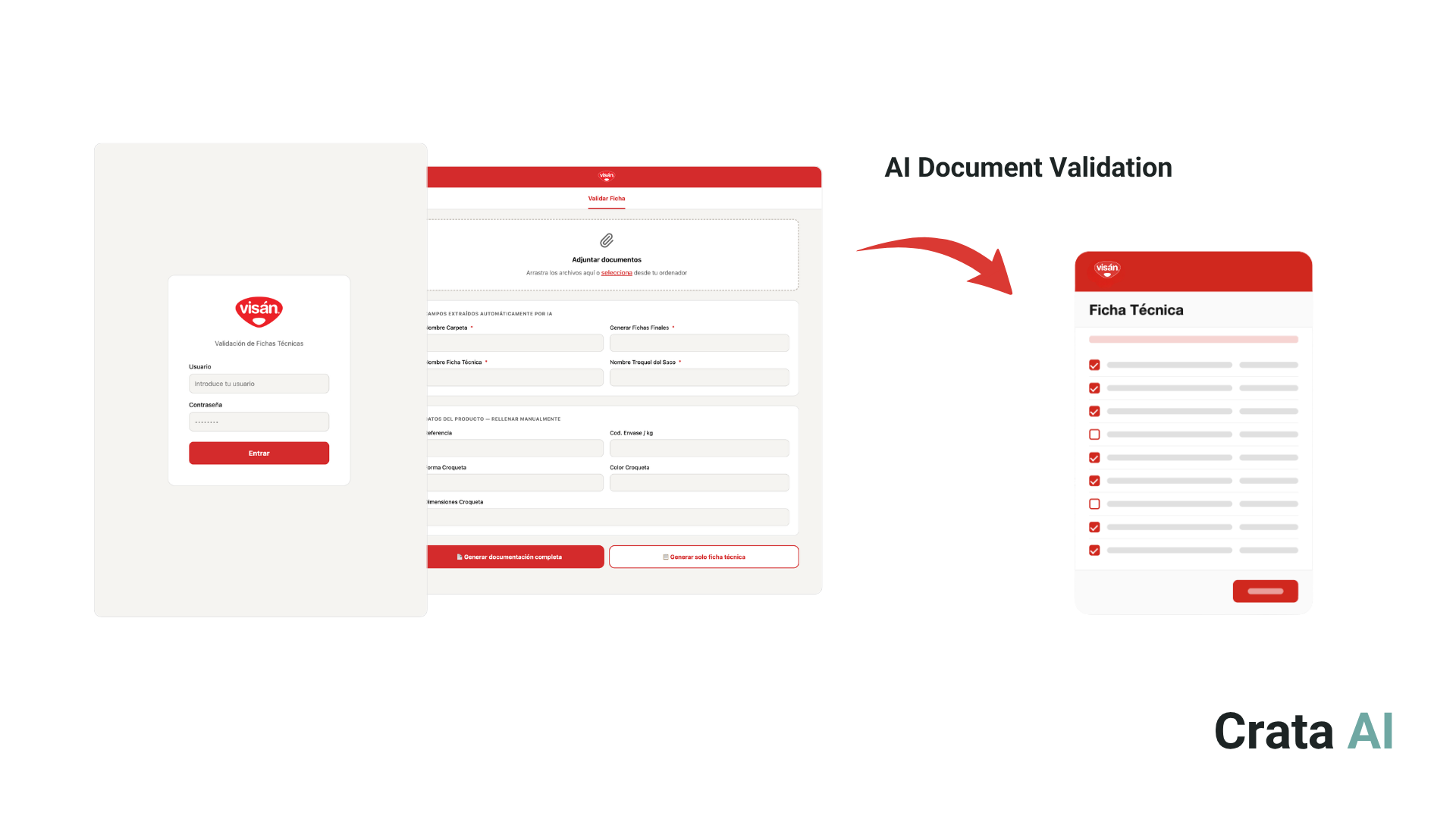
The team no longer starts from a complete manual comparison. They start from a guided review: prioritized errors, structured checklist and a final sheet generated from information already cross-checked.
In the first results from the project, Visán already saw a clear change: less time reviewing line by line, errors detected before reaching print, and greater capacity to absorb volume without expanding the team.
These are the metrics recorded after project implementation:
- ~60% less review time: from approximately 2.5 hours of manual review per document to around 1 hour total combining AI and final human review.
- 93% accuracy in error detection: when the system flagged an error, in 93% of cases it was a real error, a true positive. For the team, this means less noise and more actionable alerts.
- 94% system sensitivity: the system detected 94% of the real errors present in the test documents. This metric measures the AI's ability not to miss inconsistencies.
- +22% improvement in error detection vs. manual review: the AI identified inconsistencies between language versions that in a high-load manual process tend to go unnoticed.
- Potential saving of over 3,000 hours/year: estimated manual time the team could stop dedicating to repetitive document comparison tasks.
- 2.5x productivity in validation: the same team can review more documentation in the same operating time, because the AI absorbs the most mechanical part of the process.
Beyond the metrics, the most important change is structural: the team stopped managing a process dependent on sustained manual attention and moved to one where AI absorbs the most mechanical part and the team steps in where real judgment is needed.
AI automation vs. traditional process
Companies are looking to redesign specific processes where there is a lot of manual work, a lot of dispersed information and high cost if something fails. Document validation is exactly that kind of process.
McKinsey notes in its 2025 report Superagency in the workplace: 92% of executives surveyed expect to increase their AI investment over the next three years, but the pressure is no longer just about adopting technology, it's about generating real ROI.
In a parallel analysis on the operational impact of agentic AI, the same consultancy points out that these systems create value precisely where they break down internal silos, connect information and automate complex flows.
Document validation falls exactly into that category. It connects quality, regulation, product, marketing, design, procurement and production. A data point that changes in a technical sheet can end up affecting packaging, a translation, a commercial sheet or a final client document. If that flow is reviewed only by hand, the process scales with difficulty and risk.
Deloitte also notes in its 2025 GenAI in manufacturing analysis that one of the most promising capabilities for manufacturers is data extraction and simplification: analyzing large volumes of information, summarizing it and delivering useful knowledge to the team at the right moment.
That is exactly what happens in Crata AI systems like the one developed for Visán: the AI doesn't replace expert judgment, but it converts dispersed documents into an ordered, actionable review.
For Visán, the strategic impact was moving from a document validation process dependent on manual comparison to a flow where AI connects the packaging, the nutritional sheet, the internal rules and the final sheet.
For other companies, the same pattern can be applied to packaging, technical catalogs, commercial sheets, regulated documentation or sales materials. As happened with Crata AI's claims process automation for Tecniseguros, the advantage isn't just in saving time, but in better controlling what goes to market.
Building this system confirmed something we see in many applied AI projects: the value isn't just in automating a task, but in turning the team's operational knowledge into a repeatable process. At Visán, much of the criteria already existed: what to review, what to compare, what to validate and when to escalate a doubt. The system made it possible to structure that criteria and apply it consistently across every review.
AI contributed speed, but also order. Each validation leaves an error summary, a checklist and a final sheet generated from cross-checked information. That helps the team review better, maintain control and absorb more volume without relying on a complete manual review from scratch.
If your company manages products, technical documentation or regulated materials and document review is slowing down launches or creating operational risk, we can help you build a system similar to Visán's with Crata AI's custom AI solutions.
If you want to go deeper into how AI automation reduces errors and costs in other processes, you can read this analysis on AI automation.
Contact: info@crata-ai.com
Can an AI system automatically approve product documentation?
AI validates, compares and flags inconsistencies, but final approval must remain human (what's known as human-in-the-loop). At Visán, the system generates the error summary, the checklist and the final sheet, but the team decides and approves. That balance is what allows gaining speed without losing control or traceability.
What documents can an AI document validation system compare?
It depends on the use case. At Visán, the system compares packaging die-cuts against nutritional technical sheets in Word and PDF formats, along with internal rules, product criteria, marketing guidelines and applicable regulations. In other sectors, it can be applied to commercial sheets, technical catalogs, regulated documentation or sales materials.
Can AI validate documents in multiple languages?
Yes. The system can detect and review information by language, which is useful when a SKU is sold across multiple markets. The value is in finding inconsistencies that may appear only in one language version, for example a value correct in Spanish but mistranslated in another language.
How much does it cost to automate document validation with AI?
It depends on document volume, the formats involved and the complexity of the validation rules. It's not a standard product but a system designed for each company's specific process. The most direct way to find out is to analyze your case: you can book a call with our team and in 30 minutes we'll give you a real estimate.
In which sectors can AI document validation be applied?
Any sector where product, service or process documentation must match across multiple sources before being published, printed, sent to a client or passing a regulatory review. Food and petfood as in the Visán case, but also pharma, cosmetics, industrial, legal, retail or any company with technical catalogs, commercial sheets or regulated materials. If the team is validating repeated information across documents, AI can reduce time, errors and rework.
European Commission (2025). Alert and Cooperation Network Overview 2024
McKinsey & Company (2025). Superagency in the workplace
McKinsey & Company (2025). How COOs maximize operational impact from gen AI and agentic AI
Deloitte (2025). Generative AI in Manufacturing