AI chatbot for business: a practical implementation guide
What an AI chatbot for business does, what results it delivers and how to run a pilot you can actually measure.
.png)
An AI chatbot for business handles repetitive queries, retrieves information from internal systems, guides transactions, qualifies leads, opens tickets and escalates complex cases to the right team with full context attached. In deployments connected to live operations, it absorbs around 70% of repetitive queries without human involvement.
The difference comes from the connection to the business itself: the CRM, the documentation, WhatsApp, internal tools, escalation rules and teams ready to step in. At Crata AI we built the claims assistant for Tecniseguros, which has cut claim processing time by 90%. This guide covers what an enterprise chatbot with AI is, which types exist, what results it produces and how to design a pilot you can measure.
Table of contents
An AI chatbot for business is a conversational agent connected to an organisation's data, processes and channels that answers queries, executes tasks, guides requests and escalates cases to a human team whenever the conversation requires validation or specialist judgement.
A basic rule-based chatbot runs on closed menus. If the user types A, it answers B. That works for simple questions and breaks the moment someone phrases things differently, mixes topics or needs an answer that depends on context.
A business chatbot with AI interprets natural language, identifies intent, retrieves information from internal sources and holds the thread across the whole conversation. It can check a commercial policy, look up the status of a request in the CRM or explain an internal procedure without asking the user to repeat what they have already said.
The enterprise layer appears when the bot acts as well as answers. It opens a ticket, books a meeting, updates a record, requests a document or triggers an intelligent handoff to customer service, IT, sales or legal.
It makes sense in mid-sized and large organisations with a high volume of repetitive queries and internal systems that hold the information needed to answer them.
Installing a tool like Intercom, Tidio or a generic bot solves part of the problem. It captures messages, answers basic FAQs and provides out-of-hours availability. In mid-sized and large organisations the bottleneck sits elsewhere, in connecting the conversation to the operation behind it.
What we see at Crata AI is that many companies come to us after trying a generic tool that never connected to their real operations. The bot answered simple questions, could not query live data, could not distinguish priorities and had no clear criteria for escalation.
The outcome is service that performs worse than the manual baseline. The user repeats the information to an agent, the team checks the CRM by hand, data gets copied between systems and the expected saving disappears. At scale, that single gap multiplies across thousands of conversations a month.
An AI chatbot for business needs three capabilities that rarely come solved out of the box:
The bot should never improvise on sensitive information or answer outside its perimeter. It needs to know when to act, when to ask and when to pass the conversation to a person.
If you are still comparing tools and have not decided which process to automate first, the AI Quickstarter from Crata AI audits processes, data and opportunities before a single line of code is written.
The two clearest cases for implementing a chatbot in a company are customer service and internal knowledge. They share the same technology but solve different problems.
Customer service chatbots
An AI customer service chatbot handles frequent queries, identifies what the user needs, retrieves the relevant information and guides the request through to resolution or referral. It fits sectors with a high volume of questions about request status, documentation, coverage, orders, incidents, appointments or service terms.
With AI customer service chatbots, the value appears when the system reduces repetitive load without degrading the experience. The goal is to resolve the simple accurately and escalate the complex with context.
In insurance we built this with Tecniseguros, on WhatsApp and connected to their internal systems. The full project is covered in the automated claims processing case study.
Internal knowledge chatbots
An internal knowledge chatbot answers employee questions about processes, products, tools or policies. Instead of digging through folders, email threads and wikis, the team asks in natural language and receives an answer grounded in validated internal sources.
At Crata AI we deliver this as internal knowledge chatbots. For the architecture and use cases in detail, we cover them in how AI chatbots manage internal knowledge.
In confidential projects with operations teams we have seen two effects. Time saved on search is the visible one and the one everybody expects. The second carries more weight and is harder to measure, and it is the reduction in errors caused by outdated document versions, criteria scattered across departments and reliance on two or three senior profiles who end up as bottlenecks.
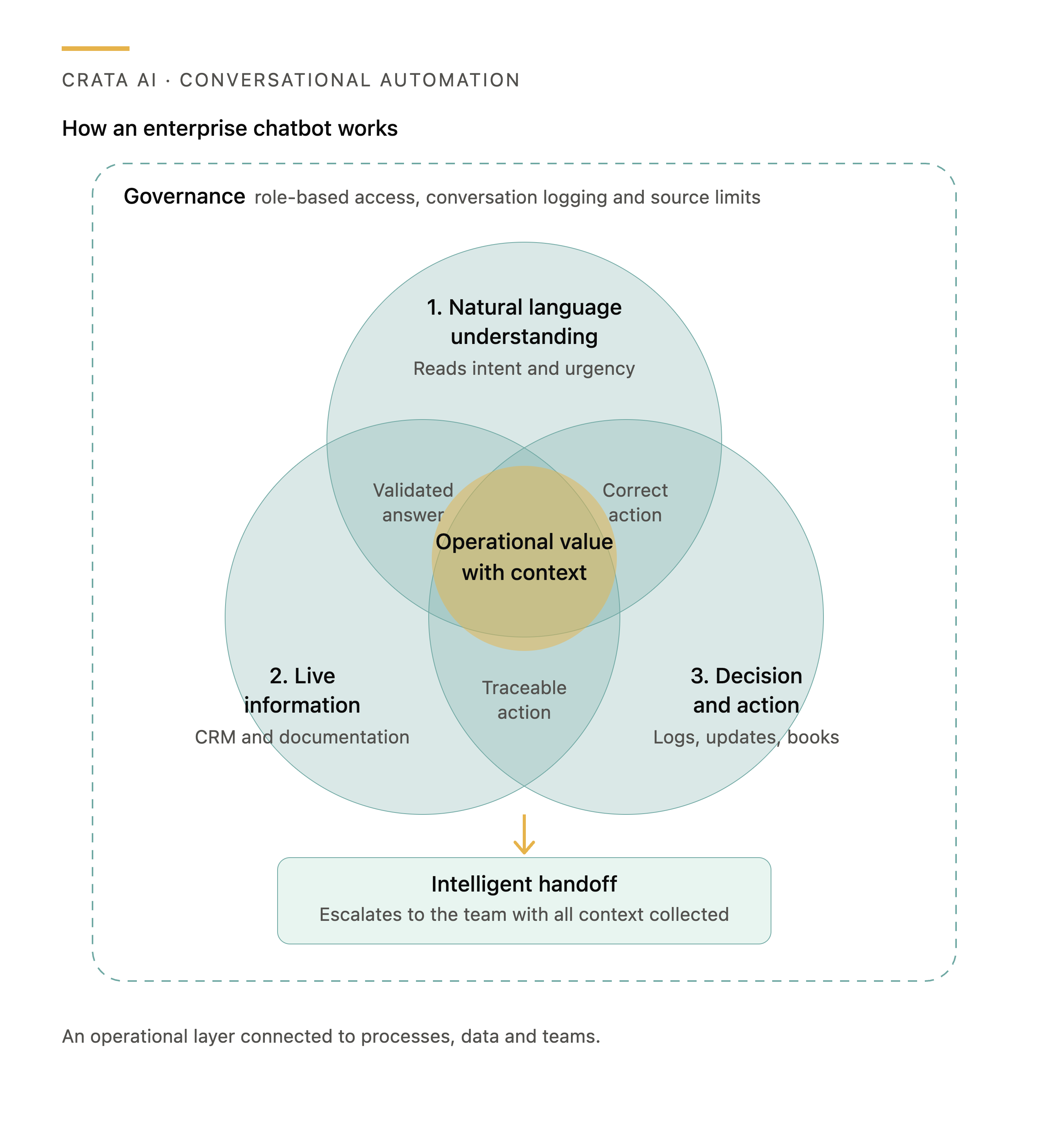
An enterprise chatbot works in layers, and each one contributes part of the result.
The first layer is natural language understanding. The system interprets what the user wants even when they do not use the exact wording from the manual, and detects whether a query is informational, commercial, urgent, incomplete or sensitive.
The second layer is access to live information. The bot queries validated documentation, the CRM, the helpdesk, knowledge bases, forms, calendars or internal systems. In insurance this layer includes automated document validation, so the system checks what the customer attaches before the case moves forward. The goal is to answer with reliable, current data rather than general knowledge.
The third layer is decision and action. An enterprise chatbot can request a missing detail, log a request, update a record or book a meeting. If it detects risk, low confidence or the need for human judgement, it triggers an intelligent handoff.
That handoff has to carry context. The agent needs to know what the user asked for, what information was collected, which sources were consulted and what remains unresolved. Without it, the human team starts from zero and the chatbot becomes one more step in the queue.
Governance sits across all three layers and covers role-based access, conversation logging and explicit limits on which sources the system may consult and which data it must never process.
Customer service
An AI customer service chatbot resolves questions about case status, opening hours, coverage or incidents, drawing on the CRM, the helpdesk or a document base.
In insurance, an assistant of this kind opens the claim through a guided flow, validates the documentation the customer attaches, adapts its response to the case type and lets the customer check the status of their file without calling anyone. When the case gets complicated, it transfers to an agent with the whole conversation attached.
Sales and lead qualification
In financial services, a WhatsApp chatbot for business collects the initial details, classifies intent, checks qualification criteria and passes the lead to the sales team with a ready-made summary. In a recent project for a financial services company, the agent handles leads outside office hours, collects the qualification data and books the meeting autonomously. The operational value lies in ordering inbound conversations before they reach sales.
HR and onboarding
HR uses an internal knowledge chatbot to resolve questions about policies, holidays, benefits, tools, onboarding or approval processes. The system queries internal documentation and reduces repeat questions to the people team, particularly during hiring peaks.
Legal and compliance
Legal uses a conversational AI agent to locate clauses, policies, templates and previously approved criteria. Automation needs clear limits here. The system retrieves and summarises, and the legal decision stays with a person at all times.
IT and internal support
IT automates frequent access requests, basic incidents, ticket status, configuration guides and priority-based routing. Connected to the ticketing system, the bot reduces manual triage and improves the audit trail on every request.
Operations and proprietary platforms
In another project, the agent is embedded in the client's order management platform and resolves queries by accessing their systems directly, escalating to a human agent with full context whenever the query calls for it.
Results depend on the process, the volume and the quality of the data. These are ours on the project with the longest track record.
At Tecniseguros, Leobot handles more than 800 claims a month, has cut claim processing time by 90% and resolves around 70% of repetitive queries without the team stepping in. Customers also resolve their questions five times faster than under the previous manual process. The channel moved from business hours to 24/7 availability, tripling the service window.
External signals point the same way. Gartner predicted that by 2027 chatbots would be the primary customer service channel for roughly a quarter of organisations, and even then 54% of respondents were already using some form of chatbot, virtual assistant or conversational AI platform in customer-facing applications.
The market follows. Grand View Research puts the global chatbot market at 9.6 B$ in 2025, 11.8 B$ in 2026 and a projected 41.2 B$ by 2033, at a CAGR of 19.6%.
%2023.39.58.png)
AI is not replacing the human service team either. According to Gartner, more than 50% of customer service organisations will double their technology spend by 2028, while only 20% had reduced agent headcount because of AI. Close to 80% plan to move agents into new roles and 84% plan to add new skills to frontline positions.
Custom-built chatbots integrate with a company's internal systems and answer with validated information. At Crata AI we have deployed solutions of this kind in insurance, financial services and distribution, with measurable results from the first weeks.
%2023.42.29.png)
The first step in any implementation is choosing the process. Most companies start by choosing a vendor, and that is where the project goes wrong.
- Identify the process with the highest manual load and impact. Look for repeated conversations, high volume, waiting times, handover errors or dependence on overloaded teams. If the process does not affect cost, speed, experience or risk, it will not make a good pilot.
- Audit the quality of the available data. Check where the information lives, who maintains it, what permissions exist and which sources are reliable. An enterprise chatbot only answers well when the underlying knowledge is organised and validated.
- Start with a bounded pilot. One channel, one process, one user group and three or four metrics. Autonomous resolution rate, average processing time, correct escalations and user satisfaction all work.
- Measure and scale on data. If the pilot works, extend channels, use cases and integrations. If it does not, review the data, the business rules or the handoff design before changing tools.
The next step depends on how clear the flow already is. If you know which process you want to automate, at Crata AI we build custom AI solutions that connect the chatbot to your systems and your business rules. And when the challenge reaches beyond the conversation into several linked processes, the answer is usually AI agents and automations covering the full chain.
The chatbot as operational infrastructure
The value of an enterprise chatbot lies in understanding the process, consulting reliable information, acting within clear limits and escalating with context when the conversation demands it.
Conversational automation works when it is designed as operational infrastructure. That means proprietary data, integrations, measurement, governance and human teams ready to step in where they add the most value.
The pattern repeats across the projects that succeed. They started with one specific process, measured the result and scaled only once the system proved its impact. The Tecniseguros assistant began with a single transaction, the guided opening of a claim, and expanded from there into the rest of the process.
If you are evaluating an AI chatbot for your business, talk to the Crata AI team and we will look together at which process has the most potential to be automated first.
Contact: info@crata-ai.com
FAQs about AI chatbots for business
What is an AI chatbot for business and how does it work?
It is a conversational AI agent connected to internal data, systems and processes. It interprets questions in natural language, retrieves validated information, answers or executes an action, and escalates to a human team when judgement or authorisation is required. What separates it from a rule-based bot is that it queries real information and acts on the company's own tools.
What is the difference between a chatbot and an AI agent?
A chatbot holds the conversation and answers within a defined scope. An AI agent plans across several steps, chains actions in different systems and works towards an outcome rather than a reply. Most enterprise deployments sit between the two: the conversational layer is the entry point, and agent capabilities are added as the process becomes more complex.
Which process should a company automate with a chatbot first?
Pick the process with the highest repetitive volume and the clearest measurable impact, where the supporting information already exists and is trustworthy. Claims intake, order status, appointment booking and access requests are common starting points. Processes that depend on unstructured judgement or on data nobody maintains make poor first candidates.
Can a business chatbot connect to a CRM and to WhatsApp?
Yes, and in enterprise deployments that connection is the point. The chatbot reads and writes records in the CRM, works over WhatsApp Business, the website or an internal platform, and reaches the helpdesk, calendars and document repositories through APIs. Without those integrations it can only return static content.
What metrics should you use to measure a business chatbot?
Track autonomous resolution rate, average processing time for the target transaction, correct escalation rate and user satisfaction. Volume handled per month gives the scale. Avoid aggregate figures such as total hours saved: they cannot be verified and they hide which process is actually improving.
What results can a company expect from an AI chatbot?
Expect fewer repetitive queries, shorter processing times, a better audit trail, out-of-hours coverage and less load on support teams. In the Tecniseguros case, the assistant handles more than 800 claims a month. Results should be measured process by process rather than in aggregate.
Gartner (2022). Gartner Predicts Chatbots Will Become a Primary Customer Service Channel Within Five Years
Gartner (2026). Gartner Predicts Over 50% of Customer Service Organizations Will Double Their Technology Spend By 2028
Grand View Research (2026). Chatbot Market Size, Share & Growth Report, 2033

%20(1)%20(1).webp)