Artificial intelligence in construction: a guide for contractors
How contractors use AI to cut timelines, automate documentation and plan complex builds, with real results and where to start.
Artificial intelligence in construction lets construction firms plan projects more precisely, automate technical documentation, anticipate schedule and cost overruns, and turn scattered project data into operational decisions. The sector has barely started: according to data presented at the I Congreso de Innovacion en Construccion (IC2, April 2026), only 11.4% of Spanish construction firms use AI today, well below industry, services, and ICT.
That gap is the opportunity if you run civil works, industrial building, or infrastructure with several fronts and subcontractors at once. This guide covers what AI can do in construction today, which use cases move the needle, what results firms already see, and where to start with judgment.
Table of contents
Artificial intelligence in construction is the use of AI models, specialized agents, and data analysis systems to automate planning, tracking, documentation, cost control, and decision-making on construction projects.
In practice, it turns scattered technical documentation into actionable information for planning, production, and operations teams.
AI does not deliver the same value to every firm. It pays off when there is real complexity on the table: civil works, industrial building, or infrastructure with many subcontractors, large volumes of technical documentation, tight tender deadlines, and a dedicated planning team.
The margin for improvement is large because the sector carries decades of low digitization. According to McKinsey, construction labor productivity has grown about 1% a year for two decades, against 2.8% for the wider economy. The same gap shows in AI adoption: according to Eurostat, 19.95% of EU firms used AI technologies in 2025, but in construction the figure drops to 10.79%, the lowest of any economic activity measured.
.png)
To size the opportunity: according to Deloitte, applying AI and advanced analytics can generate savings of 10% to 15% of a project total cost. This is not theory. In Spain, firms such as Sacyr are already piloting AI agents that cut planning time from months to days.
Planning and scheduling
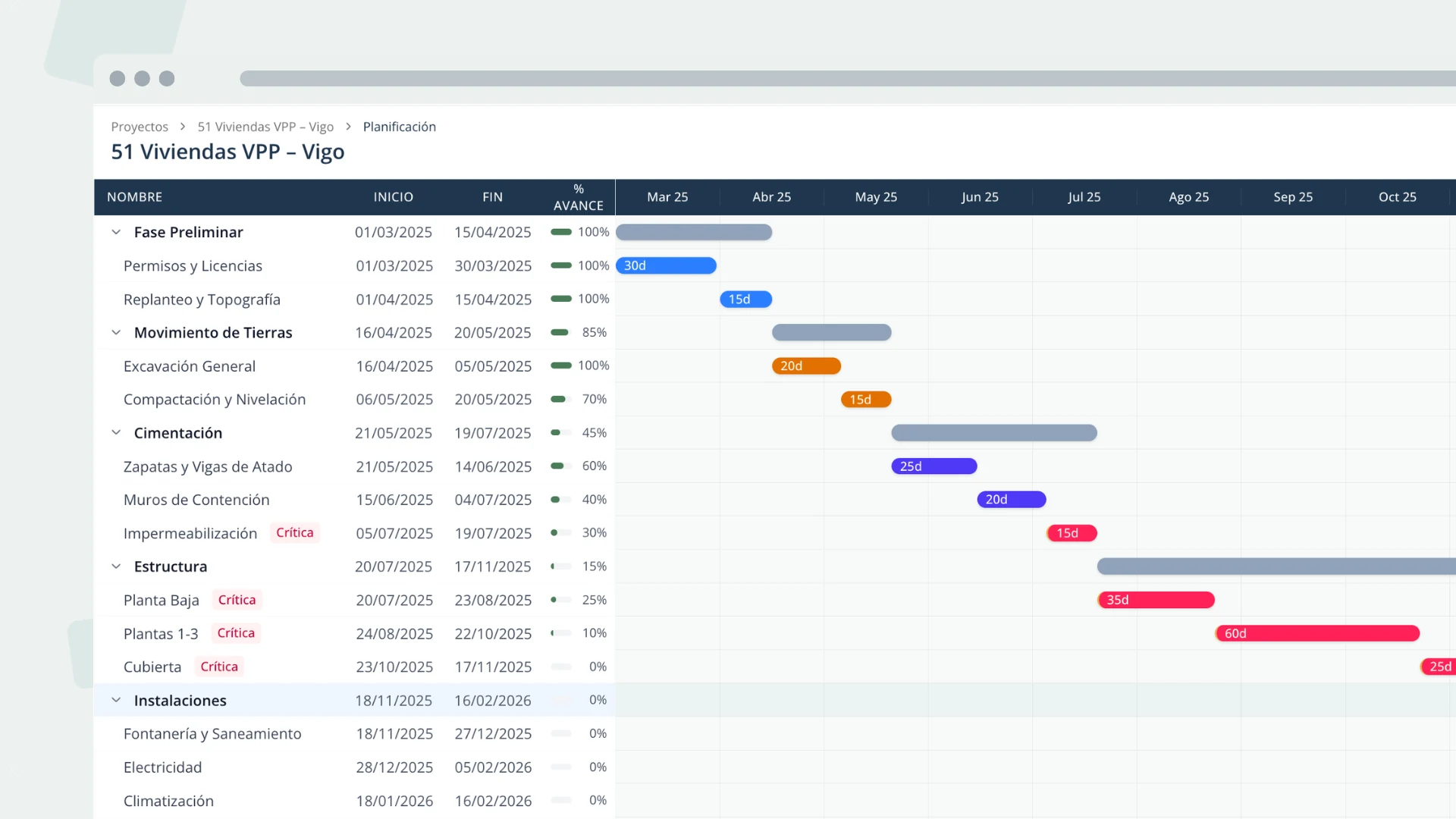
This is the clearest use case. A specialized system analyzes technical documentation, dependencies, resources, and scope changes to propose more realistic schedules and flag bottlenecks earlier. This is where Miranda AI fits, our copilot for planning teams, turning project documentation into a first structured schedule ready for review. We break it down step by step in our article on AI agents for construction planning.
Visual site monitoring and control
Most teams wait until the Monday meeting to compare real progress against plan. AI visual monitoring removes that lag: it uses images, video, drones, or 3D models to detect blocked fronts, work items running behind, or visible deviations before they reach the critical path. We cover it in depth in computer vision for site supervision.
Digital transformation of the sector
AI is the layer that makes site digitization worthwhile. Connecting project data, tools, and processes is what turns documentation into actionable decisions. Adoption moves faster in firms that have already organized their digital transformation in Spanish construction.
Automated document management
Specifications, drawings, annexes, minutes, RFIs, certifications, and measurements hide information that affects schedule, cost, and risk. AI reads and classifies these documents, extracts the key fields, compares versions, and flags what is missing. The result: fewer hours of manual review, and no critical decision left hanging on a data point lost in an email or a shared folder.
Budgeting and cost control
On complex projects, what throws off the budget is usually the sum of a thousand small changes: line items left un-updated, measurements not reconciled, deviations caught late. AI cross-references budget, progress, measurements, and procurement to anticipate the financial impact of a site decision before it shows up at closeout.
Site safety and risk prevention
AI analyzes images to detect missing PPE, incorrect access, or risk zones, and reviews safety documentation to alert when a certificate or permit is missing. Your safety lead stays in charge and gains an extra layer of detection and prioritization to act earlier, especially on sites with heavy simultaneous activity.
Construction firms that apply AI to a well-defined use case get measurable results: less time on manual tasks, tighter control of deviations, less rework, and faster decisions. We see it in four areas, and these are the data points behind each.
Planning: from months to days
This is where impact shows fastest. In the Miranda AI pilot with Sacyr, at Crata AI we estimate the process dropped from up to 3 months to 3 days: AI prepares around 95% of the initial work, and the technical team focuses on what adds value, reviewing assumptions and refining the plan with expert judgment.
For scale: on a typical project, Miranda AI processes between 600 and more than 1,600 pages of technical documentation, from the project report to drawings and measurements. There is no ceiling: all documentation is indexed in a database, and Miranda retrieves only the relevant information for each query without re-reading the whole document every time.
Deadlines: fewer delivery overruns
The baseline is hard. An El Pais analysis based on PlanRadar data reports that 90% of building projects in Europe miss their committed deadline, and that in Spain around 11% of a residential development budget goes to redoing work because of incomplete information. AI lowers that risk by catching deviations and poorly resolved dependencies earlier.
Costs: 10% to 15% savings
Deloitte estimates savings of 10% to 15% of total construction cost, and reductions of 10% to 20% in budget and schedule overruns when advanced analytics and digital execution tools are applied.
Productivity: 15% to 25% gains
McKinsey estimates 15% to 25% improvements on capital projects when advanced analytics and digital execution are combined, and calculates that closing the sector productivity gap would unlock 1.6 trillion dollars in value a year globally. The pattern is consistent: value arrives when you take administrative load off stretched technical teams so they decide earlier and with more context.
Start with a concrete question: which process costs us the most time, creates the most risk, or blocks the most decisions when we do it by hand. Based on our experience implementing AI in complex operational processes, the initiatives that work follow these four steps.
- Identify a high-impact, manual-heavy process. It can be planning, document review, progress control, or budget comparison. If the problem does not affect schedule, cost, risk, or productivity, it will not be a priority and the impact will be limited.
- Audit the data and digital infrastructure. Before building anything, understand what information exists, where it lives, how it is updated, and at what quality. That means mapping data sources, repositories, permissions, formats, and the level of integration between systems, not just reviewing documents.
- Run a contained pilot. One project, one process, one metric. In planning, that can be a Miranda AI pilot with real documentation from a few selected projects: you generate a first structured schedule and measure how much time you save against the manual process.
- Measure, adjust, and scale. Operational metrics: hours saved, errors caught, delays anticipated, volume processed, and output quality. If the pilot works, you define the next use case and scale with judgment.
Mistakes when implementing AI in a construction firm
When these steps get skipped, the pattern repeats: in our conversations with planning teams, reviewing thousands of pages of technical documentation by hand to build a schedule produces errors that stay invisible until the project is underway, when a mis-transcribed figure becomes a delay or mis-planned materials.
The most common mistake is starting with the tool instead of the process. ChatGPT, Copilot, or any generic AI help with isolated tasks, but they do not solve a construction workflow unless they are connected to the technical context, the documents, and the way your team actually works.
To find which process in your firm has the most automation potential, talk to our team and review a specific use case.
AI tools are not interchangeable. The decision should start from a single question: what problem do you want to solve.
Generic tools are useful for experimenting, but they do not know the site context or run complete workflows with traceability.
Construction management software adds structure and centralizes documents. The next step, turning those documents into actionable decisions, is where a specialized agent like Miranda AI fits: it reads specifications, drawings, and project files, extracts activities and dependencies, generates a first structured schedule, and leaves the review and final approval to you. If your case is another documentation-intensive process, we handle it with custom AI solutions for construction firms.
Artificial intelligence in construction is already an operational tool to cut timelines, control costs, automate documentation, and improve planning on complex projects. The key is choosing well: identify where manual load, data fragmentation, or lack of visibility cost you more money than you think, and start there.
For many firms, planning is the natural entry point: a critical, repetitive, documentation-intensive process tied directly to schedule, cost, and tender competitiveness. The firms that move first will be the ones that turn technical knowledge into repeatable, measurable, AI-assisted processes.
If your team is exploring how to apply AI to planning, documentation, or site control, request a diagnostic session with our team. We help you find the first use case that is genuinely worth it.
Contact: info@crata-ai.com
What are the benefits of artificial intelligence in construction?
AI in construction reduces manual work, improves planning, anticipates deviations, automates documentation, and helps control costs. Its biggest benefit shows in firms with complex projects, where there are many documents, subcontractors, dependencies, and simultaneous decisions. It turns scattered information into operational signals to act earlier on schedule, cost, and risk.
How much does it cost to implement AI in a construction firm?
The cost depends on the use case, the available data, the integration required, and the level of automation. A contained planning pilot does not cost the same as a full platform connected to several internal systems. The most sensible way to start is to define one process, one pilot project, and one impact metric before scaling to other use cases.
What is the difference between ChatGPT and a specialized construction AI agent?
ChatGPT handles general tasks such as summarizing, drafting, or analyzing isolated information. A specialized construction AI agent works on concrete site processes: planning, technical documentation, dependencies, constraints, costs, or reporting. The difference is context, traceability, and the ability to integrate with the firm real operational workflow.
Where should a construction firm start with AI?
It should start with a high-impact, manual-heavy process. In many firms that process is planning: reading technical documentation, extracting activities, ordering dependencies, and preparing an initial schedule consumes senior time and repeats on every project. A Miranda AI pilot lets you test that workflow with real documentation before scaling to other use cases.
Which construction firms already use artificial intelligence?
Adoption is still low: according to IC2 congress data (2026), only 11.4% of Spanish construction firms use AI. Among those that already apply it are large groups such as Sacyr, which has piloted AI agents with Crata AI to cut construction planning time from months to days. The trend points to mid-sized and large firms with complex projects scaling their use first.
Deloitte (2020). The Age of With: AI in construction and infrastructure
El Pais (2025). Nueve de cada 10 proyectos inmobiliarios incumplen los plazos de entrega
Eurostat (2025). Use of artificial intelligence in enterprises
IT User (2026). Solo el 11% de las constructoras espanolas utiliza inteligencia artificial (IC2)
McKinsey Global Institute (2017). Reinventing construction through a productivity revolution